Blog

LOOKING FOR CORNELIUS

reviewed by Paul Knobloch for READER VIEWS


READER VIEWS

General Fiction LITERARY FICTION SHORT STORIES, NOVELLAS & GRAPHIC NOVELS WOMEN’S FICTION

August 10, 2026

Looking for Cornelius

Diana Hayes
Resource Publications (2025)
ISBN: 979-8385250332
Reviewed by Paul Knobloch for Reader Views (08/2026)

Diana Hayes’s Looking for Cornelius follows Deirdre, a Montreal music teacher who travels to Ireland with Éamon, her gifted thirteen-year-old fiddle student, as he competes for a scholarship at Cork College University. For Éamon, the journey represents an extraordinary opportunity to turn his musical talent into a future. For Deirdre, however, Ireland offers something more personal. Orphaned at twelve when a fire destroyed her family home, she has spent years searching for information about her great-grandfather, Cornelius Ó hAodha, a Traveller from West Cork who survived the Great Hunger and eventually disappeared into the uncertainties of family history. What begins as a musical journey gradually becomes a search for ancestry, belonging, and the ways the past continues to live within us.

Deirdre and Éamon make appealing traveling companions partly because their histories quietly mirror one another. Éamon’s birth mother, Lily O’Connor, was unable to care for him because of addiction and poverty, leaving him to be raised by a loving Polish foster family. Deirdre similarly grew up in foster care after losing her parents, grandparents, and sisters in the fire. Both therefore understand what it means to live with missing pieces in their family histories. Their relationship initially appears to be that of a devoted teacher and exceptional pupil, but Hayes gradually suggests that their connection may run considerably deeper.

Music provides the first clue. Éamon possesses an almost uncanny ability to absorb traditional Irish music, playing flawlessly by ear and instinctively understanding its rhythms and ornamentations. Deirdre recognizes something ancient in his playing because she experiences much the same connection through her own fiddle. When Éamon earns the chance to perform in Cork, their trip takes them through an Ireland where music, history, landscape, and memory continually overlap. At Glendalough they encounter the legends of St. Kevin; at Cashel, Deirdre tells Éamon the tragic story of Little Nellie; and at Cobh and Spike Island they confront histories of emigration, imprisonment, religious institutions, and suffering.

Hayes does not treat these places simply as tourist stops. Each becomes another layer in Deirdre’s attempt to understand her own losses. Her private grief increasingly merges with Ireland’s collective memory, particularly when their travels bring them closer to Skibbereen, one of the areas devastated most severely during the Great Hunger. The descriptions of coffin ships, workhouses, famine graves, and desperate families can be harrowing, but they establish why recovering Cornelius matters so deeply to Deirdre. She is not merely assembling a genealogy. She is trying to give a name and story to someone nearly erased by history.

The supernatural elements become increasingly important as well. Dreams, strange coincidences, music, missing objects, and mysterious figures suggest that Cornelius himself may be guiding Deirdre toward the answers she seeks. Hayes wisely leaves enough ambiguity around many of these encounters to allow them to function simultaneously as ghost story, ancestral memory, and spiritual experience. At the Drombeg Stone Circle, Deirdre and Éamon encounter an old man who mysteriously knows their names and tells them that his wake will occur in Skibbereen two days later.

That promise leads to the novella’s emotional centerpiece. At a traditional wake honoring the famine dead, Deirdre receives a box discovered near an old hearth and bearing Cornelius Eoin Ó hAodha’s name. A mysterious man in a gray suit then reads Cornelius’s recovered letter, finally giving voice to the ancestor Deirdre has pursued for years. Cornelius recounts surviving the famine, escaping to Britain, losing his first wife and child, rebuilding his life, becoming involved with Irish nationalism, suffering a brutal attack, and ultimately returning to Cork to die. His story transforms the historical tragedy surrounding Deirdre into something intimate and human.

Meanwhile, Éamon learns that his extraordinary recital has earned him the Cork scholarship. On the return journey, Deirdre opens Cornelius’s box, where his diary and other belongings provide the final pieces of the mystery. What she discovers brings her search for Cornelius together with Éamon’s mysterious connection to Irish music in a satisfying and unexpected way.

This revelation brings the novella’s themes neatly together. Records can burn, families can scatter, names can disappear, and entire generations can be buried without markers, yet something survives—in stories, music, objects, landscapes, and people. Looking for Cornelius is ultimately less about finding one long-dead ancestor than discovering that belonging can persist despite tremendous loss. Deirdre goes to Ireland looking for Cornelius and finds not only him, but a living piece of the family she believed had disappeared forever.

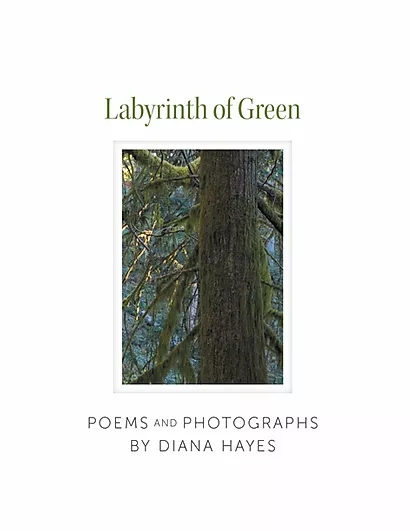
Revisiting the forest in “Labyrinth of Green”: a review by CANREADS

It has been a while since I revisted the poems in my earlier collection, Labyrinth of Green, published by Plumleaf Press. The books arrived just before the pandemic which made it impossible to carry through with my plans for a launch tour. There was just enough time to launch here at the Salt Spring Island Public Library as well as events in Nanaimo and at Vancouver’s Twisted Poets before everything shut down. I still have copies available, but the book is now essentially out of print. Reach out to me directly if you would like to order a copy directly from me.

Here is the CANREADS review:

info@canreads.ca | www.canreads.ca

Labyrinth of Green by Diana Hayes, Plumleaf Press Sometimes the wildest labyrinths only lead us back to ourselves. Labyrinth of Green by Diana Hayes is a thoughtfully curated collection of poetry and photography that embraces reflection over resolution. Rather than following a conventional narrative,Hayes guides readers through grief, memory, belonging, healing, and humanity’s relationship with the natural world. As such, the collection becomes a marvellous invitation to look inward as much as outward.

Its five-part structure mirrors the labyrinth’s inward journey. Readers first enter the forests and wetlands of Hayes’s Salt Spring Island home before travelling through adolescence, ancestral histories, death, grief, dream, and spiritual awakening. Stand-out poems such as “A Moment’s View,” “Miles for Millions and The Boxer,” and “House of the Grandmother” ground these larger themes in intimate experiences of place, identity, resilience, and home.

One of the collection’s most compelling features is its photography. Carefully chosen images of forests, flowers, coastlines, birds, and landscapes provide moments of visual grounding between the poems’ more abstract reflections. Together, they create an uniquely immersive reading experience, offering quiet moments of consideration before readers continue through the collection. The seamless partnership between poetry and photography leaves a lasting emotional impression, encouraging ongoing contemplation.

Hayes’s natural imagery is particularly evocative. Forests become places of refuge and self-discovery; birds carry grief, freedom, and transformation; water connects memory with renewal. As Hayes writes, “Poems connect us. They are ambassadors when grief blinds us,” while another moving passage reflects, “Home is where the heart lives. We may search for restless decades for this one soulful place.” In Hayes’s hands, the natural world becomes both a map of memory and a pathway toward healing.

Labyrinth of Green’s greatest strength is also its central challenge. Hayes frequently employs uncommon vocabulary, niche references, and layered symbolism that invite careful interpretation. References such as the “medivac bird” reward close reading but could feel elusive for those unfamiliar with the symbolism. The contextual introductions and extensive notes offer helpful guidance, though some poems may require considerable reflection before their emotional significance fully emerges. Readers who enjoy poetry that invites multiple interpretations will likely appreciate this complexity, while those seeking immediate clarity may occasionally feel distanced from the work.

Readers who appreciate reflective, nature-inspired poetry such as Mary Oliver’s will find much to admire here. Hayes transforms forests, memory, and grief into landscapes readers can wander through, discovering something new with every return. Beautifully photographed and deeply reflective, Labyrinth of Green is a meaningful collection to savour rather than rush through—one that rewards patience, reflection, and repeated visits. —CANREADS BOOK REVIEW

BC REVIEW OF BOOKS ‘A deep sense of returning’

September 19, 2025

Looking for Cornelius
by Diana Hayes

Eugene: Resource Publications, 2025
$21.00 / 9798385250332 

Reviewed by Trish Bowering

*

For many, the search for one’s ancestry is deeply important and meaningful. Salt Spring Island-based writer Diana Hayes has penned a captivating tale of one woman’s search for her Irish roots, offering a story that invites the reader to explore Irish history and experience a bit of magical connection to the past in the process. Hayes, a prolific poet (Sapphire and the Hollow Bone), has now turned her pen to prose, and Looking for Cornelius is her debut novella.

Deirdre Ó hAodha has taught traditional Irish music at the prestigious Academy of St. Anne’s in Montreal for the last five years. A fiddle player who had toured with a travelling Irish band, the position at St. Anne’s is her dream job, and she’s been mentoring young musicians who have a passion for the old Irish lyrics and composition. Her students come from disadvantaged backgrounds in the inner city.

Author Diana Hayes (photo: Ramona Lam)

One student, Éamon, shows particular promise on the fiddle: “He would disappear into the music as an oarsman slips off the edge of the world, beyond the veil to a place only his imagination could follow, beyond the rogue waves of a mid-Atlantic Sea.” Deirdre selects the young teen as the student who will accompany her to Ireland for the Cork County Arts Council summer festival. If Éamon’s performance scores are high enough, it could mean a full music scholarship to Cork College University.

Before the two embark on their overseas journey, Hayes introduces a third character: Deirdre’s lost-to-history great-grandfather Cornelius, born Ireland during the Great Hunger, a devastating famine in that region from 1845-1852 that led to mass starvation and hardship, and is estimated to have killed a million people. It also triggered a mass emigration, and Deirdre believes that Cornelius was one of those souls who left Ireland at that time, though she knows little else. Deirdre was born in Toronto, raised in a household with her parents, sister and grandparents, until she lost them all in a house fire at age twelve. The only survivors were Deidre, her cat Roo, her precious Ogham pendant, and her fiddle.

The author ‘researching’ at Dun Aengus years ago (photo: courtesy Diana Hayes)

The story of Cornelius has been with her most of her life. It had been family lore that Cornelius had “second sight,” and Deirdre is similarly blessed. It’s a mystery how her fiddle was saved from the fire that fateful night, but one suspects Cornelius somehow had a hand in it. Now, as the story of Deirdre’s trip to County Cork begins, her Ogham pendant is missing. Hayes writes, “Had Cornelius visited in the night again to play tricks just to have a bit of fun with her and make his presence known?” It had been gifted to her by her Granny Moll and represents her connection to Ireland—‘Ogham’ is the first known written representation of the Irish language, found on inscriptions from the Ogham Stones primarily found in counties Cork and Kerry.

Talismans like the pendant, as well as dreams, play a significant role in the story. Hayes effectively portrays the longing that Deirdre has to connect with her ancestors, and it’s a part of her protegé Éamon’s life too, as they were both orphaned at a young age. Those losses are key to the story and explain Deirdre’s excitement about her trip to Ireland; she sees it as a homecoming. Once the pair land in Ireland they rent a car and have time for sightseeing, but Deidre’s heart is pulled towards the Cork County of Cornelius’ past. She knows that the drive there “would conjure a deep sense of returning, a magnetic pull towards Cork and the Celtic Sea where her heart would beat stronger and steadier, bringing a sense of reunion, a place of belonging.”

The author ‘researching’ at Inis Mor years ago (photo: courtesy Diana Hayes)

Hayes includes some traditional Irish lore and legends in her narrative, which adds to the sense of place. When they hike to Glendalough to visit the cell of St. Kevin, we learn about the saint, with his “healing powers and love of nature.” Deirdre recounts the tale of St. Kevin and the blackbird to Éamon, in which the saint holds his arm extended for a fortnight to allow a blackbird to nest. I also learned a bit about St. Brigid, “the patron saint of healers and poets as well as creativity and womanhood,” as Deidre plays “St. Brigid’s Jig” on her fiddle before the pair leave for Dublin.

Indeed, music plays a huge role in the book, and adds so much. I had a great time listening to “St. Brigid’s Jig,” when I came to that part of the book–it brought the story to life! A traditional song, “The Parting Glass,” is featured as a melody played at the end of the annual St. Anne’s concert in Montreal, and again when Deidre and Éamon visit a pub in Cobh, where lauded Irish musician Freddie White is playing. White, I was interested to learn, is an actual Irish singer-songwriter, and after I finished the book, I took the time to look him up and listen to some of his music. I also listened to several renditions of “The Parting Glass.” The book would do well with an accompanying soundtrack, to be sure. 

Sites of the travelogue

In Skibbereen, they are met by historians from the Skibbereen Heritage Centre as well as the chair of the Ó hAodha Family Circle of West Cork, an ancestry group that Deidre has connected with. The narrative plays out gradually and beautifully as Deidre is able to finally connect with past. Discovering more about the real Cornelius’ life and times, and his eventual fate, was a highlight of the novella. There are some surprises, too, for both Deidre and Éamon.

Looking for Cornelius is an engaging story that encourages us to look at the meaning of history, family and ancestral connection, and Hayes uses the ideas of second sight, dreams, and portents to explore this idea. It’s a poetically written novella that invites contemplation, and the sense of musicality that runs throughout adds to the sense of enchantment. The descriptions of important Irish locales, accompanied by stories from the past, were so lovely. This book would make particularly excellent reading for anyone planning a trip there, as well as those interested in Irish history or ancestry.


*
Trish Bowering

Trish Bowering lives in Vancouver, where she is immersed in reading, writing, and vegetable gardening. She has an undergraduate degree in Psychology from the University of Victoria, and obtained her M.D. from UBC. Now retired from her medical practice, she focuses on her love of all things literary. She blogs at TrishTalksBooks.com and reviews on Instagram@trishtalksbooks. [Editor’s note: Trish has recently reviewed books by Patrick TarrDavid BergenMikaela ReubenNatalie AppletonNick PerryBrian Thomas IsaacSusan JubyDavid Asher, and Alison Acheson for BCR.]

*

The British Columbia Review

GULF ISLANDS DRIFTWOOD reviews “Looking for Cornelius”, written by Sandi Johnson

Arts & Entertainment

Beauty and power of music, poetry in novella by Diana Hayes

ByContributed Article

November 27, 2025

BOOK REVIEW BY SANDI JOHNSON

Looking for Cornelius, a novella, is driven by the blood-borne need to know family.

Diana Hayes, Salt Spring Island poet and publisher of Raven Chapbooks, takes us on the journey, a cartography of genes. In her poem Fiddles and Fire, Hayes articulates the passion for family that drives the narrative of this story.

Deidre hAodha, a teacher of traditional Irish music, and her young pupil Éamon, a prodigy, journey from Montreal to the Cork County Council summer festival where Éamon will compete for a music scholarship. Both tragically orphaned, they’re searching for answers about family and belonging. Deidre’s quest is to unearth the story of her great-grandfather Cornelius hAodha, who disappeared in 1847 during the crisis of An Gorta Mór, the Great Famine.

“Nothing would keep her from learning the truth about her family of origin,” the author writes about Deidre.

Éamon searches for the means to follow his heart’s desire. He asks the lord of the fiddle to help him win a scholarship. Music moves through the body like a dancer moves weightless through air; music will make all things possible.

The novella, a discovery of worlds beyond the everyday, is accompanied by the beauty and power of music and poetry. Deidre felt the presence of Cornelius; she knew the scent of his Irish Flake tobacco; heard the music of his tin whistle. She heard his voice saying, listen for messages in song.

Impeccably researched, scenes are filled with details from various disciplines that locate the reader in the history and mythology of the place. We’re given maps, explicit direction. On the way to Cork take M8 to Dunkettle Interchange, twenty minutes further, over Belvelly Bridge is the way to Cork College.

It’s a story of mystery unfolding, dreams where everything begins. Deidre and Éamon dreamed of ancient places, dreamed of saints. She recalls Jacob’s dream of the ladder, the divine connection between heaven and earth.

There were unsettling stories and much mournful music.

Prayers offered, blessings to the goddess Áine for a long warm summer, they were accompanied by St. Brigid, St. Kevin, Little Nellie whose expression of love through her faith allowed her to withstand the unrelenting pain of her infirmities.

In their search for ancestors, Deidre and Éamon visited ancient sites on their way to Cork — Scully’s Cross, the Dromberg Circle, Druid’s Altar. They wanted to prepare their hearts, to connect with the ancients. As the sun set at the Druid’s Altar, they listened for messages from the Druids.

A glossary of Irish Gaelic words and phrases is provided. The way to Dromberg Circle —take N71 west to Ross Carberry, turn left onto R597. The sign is also written Cloch-Cheacall Agus Cairn, Irish Gaelic, the mother tongue for two orphans returning home.

The novella evokes natural and spiritual worlds. The waterfall is the best place to look for the invisible, to visit the Otherworld. The sacred hawthorn, Sceach Gheal, is considered a gateway between this world and the next. St. Kevin, the Irish St. Francis, heard the trees sing sweet songs to him. When Éamon victoriously played The Song of the Faeries, voices of spirits and whales that circled off Dingle peninsula were heard.

Not far along the N71 from Clonakilty they came to Skibbereen. In Skibbereen, near Abbeystrowry, Deidre met with her ancestry group and witnessed a dramatization of The Famine Story. Skibbereen, magnet of misery, the horrors of An Gorta Mór.

In Part Three, This is My Story-The Wake of Cornelius, the mystery unfolds. The writing is deft, poetic. The voice authentic, Cornelius is totally present.

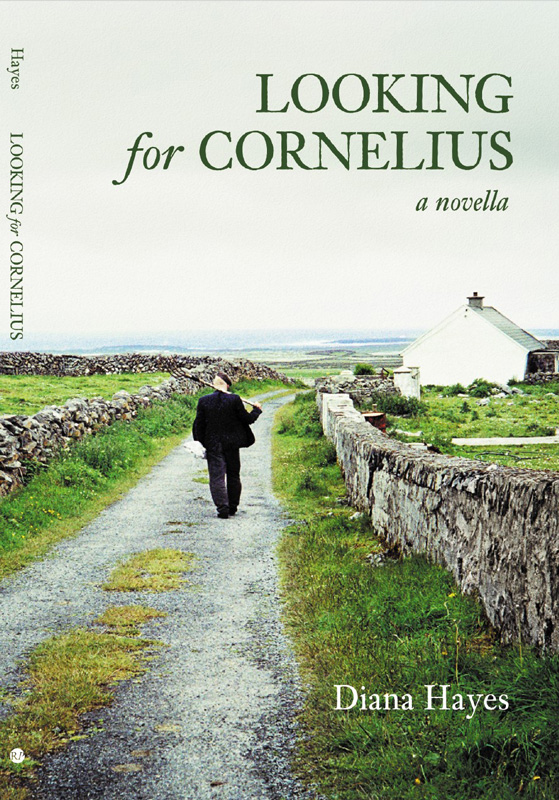
On the cover we see an old man walking down a rocky path toward the horizon. Empty spaces fill with green. In Looking for Cornelius, photographer Diana Hayes, compelled to discover the cartography of genes, has searched for her great-grandfather.

It’s a story for readers interested in ancestry: poetry and music lovers, the Irish; people who like to lift a Guinness and jig.

Books are available at Salt Spring Books.

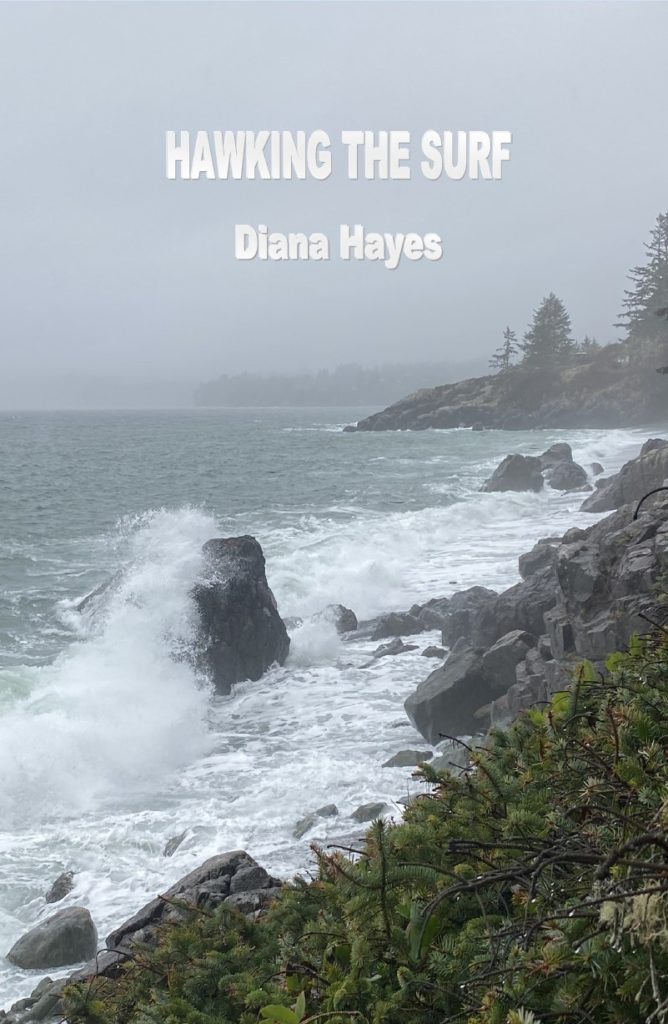
HAWKING THE SURF

Silver Bow Publishing, December 2025

Hawking the Surf is an invitation to wholeness, art in every breath. In wordsmithing wizardry from earth to sea, Hayes steers us through heavy storms, her call for compassion permeating as we battle mortality in the search for meaning. She evokes universal knowing, every leaf and wave realms of intergenerational connection, literary traditions woven like DNA, all of it alive. With symbolism seeping through photos like “Bridging the White Water” and close ups of roses and dragonflies, musicality hooks readers, then transports them beyond words to mood and time, to that space within, that paradoxical connection with eternity in moments of peaceful presence. Poems like “How Do You Spell Joy?” and “Walk the Labyrinth” invoke reverence, to open to the unique flavor of now, while others like “Memory of Wonder” are perceptibly restorative. “I see you in the apple trees next to the gabled shed/ climbing, always reaching higher…/ Know I will be there in the flowers—/dahlias, hydrangeas, dianthus, pansies,” Hayes writes of loved ones looking on, then passes the torch to readers, “Your hand now holds this pen—/your poem forms the song./ Sing now, I am not far on the wind.” For every connoisseur of literature and every emerging writer seeking the way—if you only buy one book of poetry, this should be it.

–Cynthia Sharp, WIN Vancouver Poet Laureate & Award-winning Author of Ordinary Light & Rainforest in Russet (Silver Bow Publishing)

Imagine a meeting between Robert Frost and David Attenborough, and they make poetry together. Hawking the Surf is it; a masterpiece that takes the reader on a grand journey to the Western shores on the wings of butterflies. As you travel through the latitudes, share in the memories and dreams of the poet, you will undoubtedly be carried on as this reader was. This is a collection that you will want to read again and again, something not so common with poetry anymore. It is full of emotions, passions, and realities that are most relatable to all of us. Although you may never have traveled to those realms, you are certain to experience them as if you had. The author gives us access to an entire natural world, and we want to hug it with all our might, love it, and preserve it, however much pain we may have to endure as we do so. This is a winner written by one but made for all.

–Fabrice Poussin, Professor, Shorter University, Rome, Geogia U.S.A. and author of: Through the Lens of Solitude; Forgive Me For Dreaming; In Absentia; Half Past Life; and The Temptation of Silence

A Journey of Familial Discovery- “Looking for Cornelius”

Looking for Cornelius, a novella by Diana Hayes

Secrets to be uncovered. A journey of familial discovery. A once-in-a lifetime trip. Looking for Cornelius by Diana Hayes is an epic, heart-forward adventure that’s not to be missed.

Continue reading “A Journey of Familial Discovery- “Looking for Cornelius””

George & Angela McWhirter – Synchronicities

I received letters recently from Angela and George McWhirter after they read my newly published novella, “Looking for Cornelius.” I thought the book might conjure a memory or two of their own ancestors and homeland in Ireland.  With their permission, I share their lovely letters:
 

George & Angela at the Salt Spring Island Public Library for George’s reading, May 2025

Continue reading “George & Angela McWhirter – Synchronicities”

Looking for Cornelius – a novella

Friends have asked how my novella began… Looking For Cornelius by Diana Hayes

I think that would be a story of its own, but it links closely to genealogy and my search for my paternal great-grandfather. I discovered cousins through Ancestry’s DNA program who were also direct descendants of Cornelius. They shared some dramatic narratives and a few photographs but none of us had a full picture of who he was and the tragedy that befell him, resulting in his death in Southwark, Central London. Some cousins called it a murder.

Continue reading “Looking for Cornelius – a novella”

GOLD IN THE SHADOW: Twenty-Two Ghazals and a Cento for Phyllis Webb

A LETTER FROM CATHY FORD, poet and fiction writer, publisher, editor, and teacher — on GOLD IN THE SHADOW
[photo of Cathy by Dwain Ruckle]

Without going too far into the places where many – myself, certainly – have honed our ideas about poetics, and books of poetry, and the various véhicules of the poetic voice, may I say this is the most beautiful book I have yet held in my hands. You may know, since we have shared a marvellous publisher, and much west coast sensibility through the years, that I have certainly seen and read some truly glorious books already. Including those so special due to their sheer simplicity in serving the poems, their margins, type, illustrations, their endsheets, their care and contribution to poetry, all attentiveness, especially poetry by Canadian women. Continue reading “GOLD IN THE SHADOW: Twenty-Two Ghazals and a Cento for Phyllis Webb”